Can a WiFi Router Identify People? KIT Research Says Yes
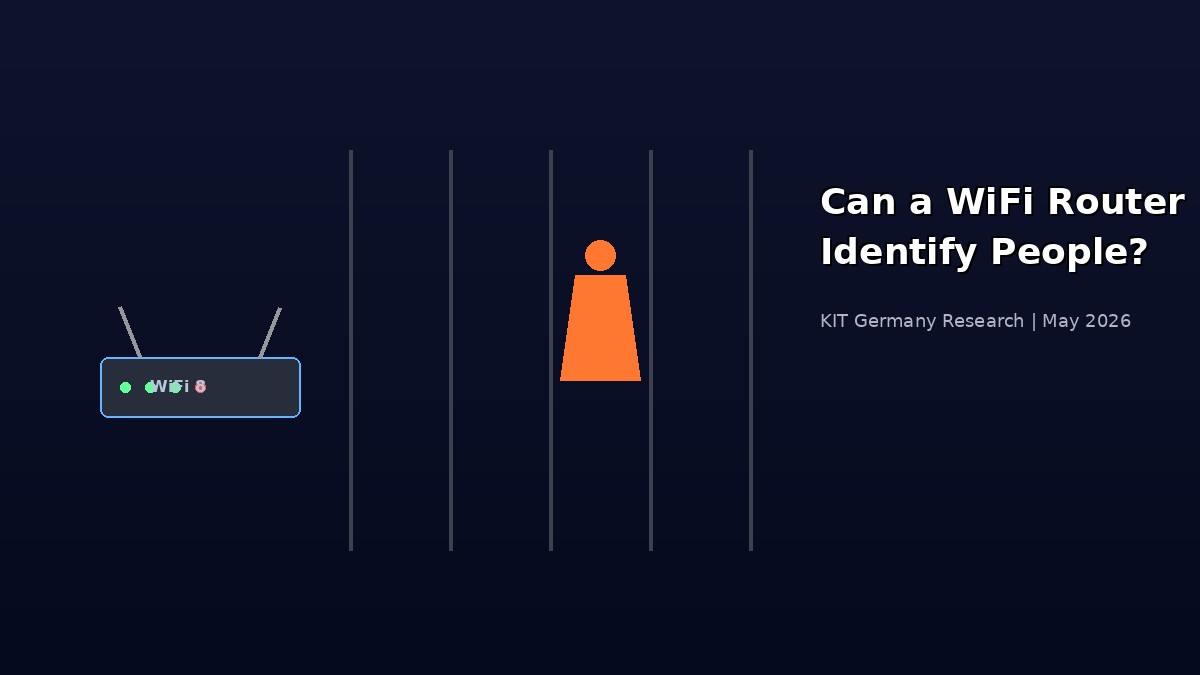
Table of Contents
- How a WiFi Router Can Identify People Through Walls
- What KIT Germany Discovered in May 2026
- Privacy Risks for Home Internet Users
- How to Protect Your Home from WiFi Surveillance
- Frequently Asked Questions
Could your home WiFi signal expose your identity? New research from KIT Germany reveals that a standard wifi router identify people with surprising accuracy. This breakthrough uses radio wave analysis to detect human shapes through walls and doors. Recent advances in machine learning have turned this once theoretical risk into a practical reality for every connected household. Home internet users must now rethink their privacy, security, and trust in everyday networking hardware.
How WiFi Router Identify People Through Walls
WiFi signals travel through your home in constant radio waves. These waves bounce off walls, furniture, appliances, and people. When a person moves, they subtly change the signal pattern around them.
Researchers call this measurement channel state information, or CSI. Standard routers already use CSI to maintain stable connections between devices. However, new artificial intelligence algorithms can analyze these patterns in far greater detail. Therefore, a wireless router can identify people by their unique body shape, size, and gait.
The system does not need cameras, microphones, or special motion sensors. Radio waves pass through drywall, glass, and wood with ease. Consequently, detection works even when you are in another room or behind a closed door. This capability creates both exciting opportunities and serious privacy concerns for modern households.
Every device connected to your network constantly exchanges signals with the access point. Each human body distorts these signals in a signature way. Even standing still, your body absorbs and reflects signals differently than furniture or pets. Machine learning models can now isolate those distortions and recognize specific individuals over time.
What KIT Germany Discovered in May 2026
Scientists at the Karlsruhe Institute of Technology published their groundbreaking findings in May 2026. They trained a deep neural network on standard WiFi signals captured from ordinary home environments. The results were both remarkable and sobering.
The system achieved near-perfect accuracy in identifying individual people. It could reliably distinguish between family members, roommates, and complete strangers. Moreover, it worked with common modern WiFi 8 router hardware already available in millions of homes.
The research team exploited existing IEEE 802.11 protocols without requiring firmware modifications. Because of this, the underlying technology could be deployed quickly across existing commercial networks. In other words, no special equipment is necessary to make this work in the real world.
This study proves that home internet infrastructure is far more powerful than most consumers assume. Scientists warn that WiFi surveillance is now possible with basic equipment found in any living room. The implications for residential privacy are profound, immediate, and largely unregulated today.
The KIT team emphasized that their goal was to raise awareness. They hope manufacturers will build privacy safeguards into future firmware releases. Until then, consumers remain exposed to potential misuse of this readily available data.
Privacy Risks for Home Internet Users
Most homeowners trust their network for basic internet connectivity and entertainment. Now, that same network could become a silent tracking tool inside your walls. Criminals, advertisers, or intrusive landlords could exploit this data without ever entering your property.
Anyone within signal range could theoretically capture and analyze your WiFi transmissions. They might learn when you are home, how many people are present, and even the specific identity of each resident. Therefore, your smart home must account for the fact that a wifi router identify people. Your smart home security systems must now include signal-level protection alongside cameras and locks.
Current privacy laws do not clearly regulate WiFi-based person identification. Data protection frameworks were written primarily for video cameras and audio recorders. Radio wave surveillance remains in a legal gray area across most countries. This gap leaves ordinary families vulnerable to invisible monitoring they cannot easily detect.
Furthermore, internet service providers and router manufacturers may collect telemetry for product improvement. That same data could reveal movement patterns and occupancy schedules. Homeowners need clear answers about what information their hardware gathers and shares.
How to Protect Your Home from WiFi Surveillance
Fortunately, homeowners can take practical steps today to reduce their exposure. Start by reviewing your router placement, settings, and firmware version immediately.
Move your router away from shared walls, windows, and exterior doors. This simple change reduces the signal footprint available to neighbors or passersby. Additionally, enable the strongest available WPA3 encryption to block unauthorized network access and passive sniffing.
Consider disabling older legacy protocols that leak more metadata. Reduce transmit power in smaller homes if your firmware allows it. Some WiFi-based person identification techniques rely on capturing broad signal leakage. Therefore, limiting range directly limits risk.
Regularly update your router firmware to patch known vulnerabilities. Contact your manufacturer and ask whether they collect channel state information. Pressure for updates that add signal noise or anonymize metadata could protect millions of households simultaneously.
Finally, consider creating a separate guest network for visitors and IoT devices. Segmentation limits the data available on your primary network. These small adjustments add meaningful layers of defense against emerging radio wave tracking methods.
Radio wave person identification represents a turning point for home internet privacy. Consumers deserve transparent hardware, enforceable regulations, and easy controls. Until those arrive, awareness and basic router hygiene remain your best defense against invisible surveillance.
Frequently Asked Questions
Can any standard router identify people without special hardware?
Yes. The KIT Germany study used standard consumer routers already sold in stores. The identification happens through software analysis of radio wave reflections and channel state information. No extra cameras, microphones, or dedicated sensors are required. The research shows that any wifi router identify people simply by analyzing signal patterns alone.
Is it legal for someone to use WiFi signals to identify people in my home?
Current privacy laws lag behind this technology. Most existing regulations cover video and audio recording. WiFi-based radio wave tracking often falls into an unregulated or loosely defined zone. Homeowners should stay informed, demand legislative updates, and secure their networks proactively.
How can I stop my router from identifying people in my household?
Use strong WPA3 encryption, reduce signal range, and place routers away from shared walls. Disable unused legacy protocols and contact your manufacturer about privacy-focused firmware updates. These combined steps lower the accuracy and feasibility of any external signal analysis.